
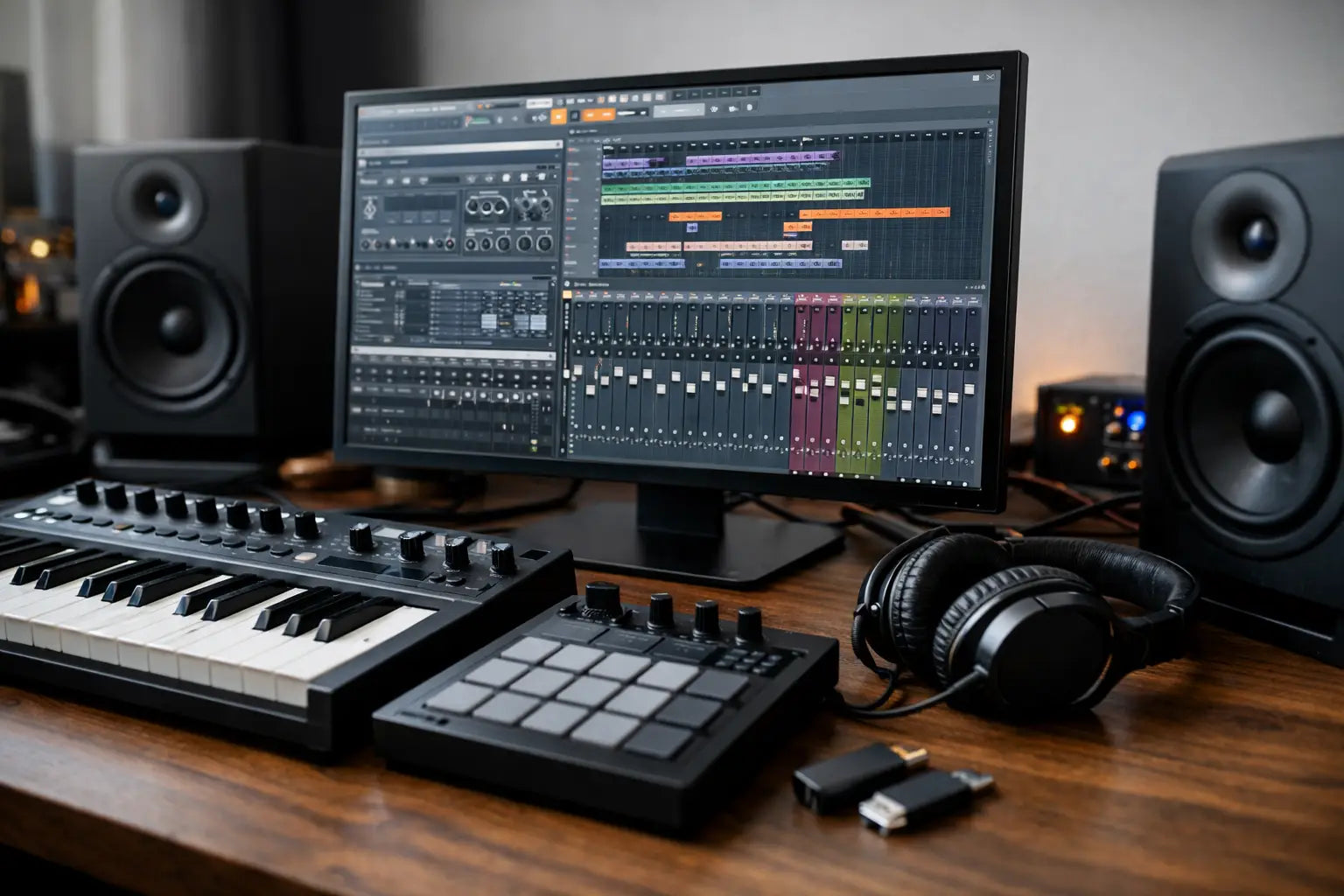
If your kick hits but the track still feels flat, the problem usually is not FL Studio. It is the source material. A strong FL Studio techno pack can change the speed and quality of your session fast - not because it makes decisions for you, but because it removes weak sounds, bad layering, and generic loops from the equation.
Techno production lives or dies on details. The low end has to stay firm without swallowing the groove. Hats need motion without turning brittle. Synths need pressure, space, and tension at the same time. When your pack is built for modern club records instead of broad "electronic" use, you spend less time fixing and more time arranging, automating, and finishing.
What makes an FL Studio techno pack worth using
Not every techno pack fits FL Studio well, even if the marketing says it does. Some are just folders full of random WAV files with no real consistency in key, energy, or mix balance. Others sound polished on their own but fall apart once you try building a full arrangement around them.
A useful FL Studio techno pack should feel organized from the first drag-and-drop. The drums should already sit in a similar tonal lane. The bass shots and synth loops should reflect actual techno phrasing, not recycled EDM ideas with a darker label. Presets, if included, should respond well inside a real project instead of sounding big only in a demo clip.
That matters more in FL Studio because workflow is fast by design. Producers use the Channel Rack, Piano Roll, Playlist, and browser to move quickly. If your samples are inconsistent, that speed works against you. You can sketch a loop in five minutes and then waste an hour trying to make mismatched sounds behave.
The real job of a techno pack inside FL Studio
A good pack should not replace production skill. It should remove friction.
That means cleaner decisions early in the process. You pull in a kick, clap, ride, rumble layer, and percussion top loop, and they already point in the same direction. You open a synth one-shot or Serum preset and it lands near the tension, grit, or movement you want. From there, your energy goes into groove design, automation, transitions, and arrangement instead of rescue work.
For techno, that is a major advantage. This genre is less forgiving than people think. Repetition only works when the sound design carries weight. Subtle modulation, transient shape, and stereo control all matter more when a loop runs for 16 or 32 bars. Weak source sounds get exposed fast.
Choosing the right FL Studio techno pack for your style
Techno is not one lane, and that changes what a pack should contain. If you produce peak-time or warehouse-oriented tracks, you probably need punchy kicks, industrial percussion, dark synth stabs, distorted textures, and FX that help create pressure without sounding cheesy. If you lean melodic or hypnotic, the pack should offer more tonal movement, atmospheric tops, evolving synth material, and cleaner low-end options.
This is where many producers buy the wrong thing. They search for a broad FL Studio techno pack, then end up with content that only covers one sub-style. The sounds may be high quality, but they do not fit the records you are trying to make.
It is worth checking whether the pack is built around drums, melodic content, presets, vocals, or a full toolkit. A drum-heavy pack can be enough if your main issue is groove. A fuller pack makes more sense if you want to build tracks faster from a blank project. Neither option is automatically better. It depends on whether your bottleneck is inspiration, sound design, or arrangement speed.
Samples, presets, and project flow
FL Studio producers often work in a hybrid way. You might start with audio loops, replace some elements with one-shots, then layer original MIDI parts using Serum or stock synths. The best techno packs support that kind of workflow instead of forcing one method.
One-shots are usually the safest starting point. They give you more control over rhythm and phrasing in the Channel Rack and Piano Roll. That is especially useful for kicks, hats, percussion, stabs, and bass hits. Loops can still be valuable, but more as momentum builders, layering tools, and arrangement shortcuts than as the whole foundation.
Presets are where the trade-off gets interesting. A solid Serum bank inside a techno pack can save serious time if you want movement and identity fast. But presets are also easier to overuse. If everyone loads the same patch and leaves it untouched, tracks start sounding interchangeable. The better move is to use the preset as a launch point, then reshape envelopes, filter movement, unison, distortion, or macro mapping to make it yours.
What to look for before buying
The best packs usually reveal their quality in boring ways first. File naming, folder structure, gain staging, and category separation matter more than flashy artwork. You want content that drops into a session without level chaos or endless auditioning.
Pay close attention to drum quality. In techno, bad drums are expensive because they force a chain reaction of fixes. If the kick is weak, you overcompensate with saturation. If the hat loop is harsh, you start carving EQ holes that kill energy elsewhere. If the percussion lacks groove, you keep adding layers until the mix turns crowded.
It also helps to look for genre focus over pack size. A giant library sounds appealing, but 2,000 average files are less useful than 200 strong ones. Producers working seriously in club music know this already. Too many options can slow you down as much as too few.
At Hot Grooves, that is why the strongest products tend to be tightly aimed at specific club lanes rather than trying to cover every dance genre in one folder. It makes shopping easier, but more importantly, it makes producing faster.
How an FL Studio techno pack speeds up finishing tracks
Starting tracks is easy. Finishing them is where most producers lose time.
A focused pack helps because it reduces the number of times you need to stop and solve a basic sonic problem. When your low-end tools already work, your transitions already sound current, and your percussion already carries club movement, it is easier to move from loop to full arrangement. You hear where the breakdown should open up. You know which texture can evolve through automation. You are not second-guessing every sound choice.
This becomes even more useful if you make music for DJs, labels, or release schedules. The goal is not just inspiration. The goal is repeatable output. You want a workflow where you can open FL Studio and get to a competitive draft quickly, then spend your best attention on the details that actually separate a good track from a playable one.
Common mistakes producers make with techno packs
One mistake is stacking too many premium sounds without giving each one a role. Just because every sample sounds big does not mean they belong together. Techno still needs hierarchy. The kick leads. The percussion supports. The synths create tension. The atmosphere fills space without blurring the groove.
Another mistake is leaning too hard on loops. Loops can make a session feel productive, but if you never break them apart, your track can stay static. FL Studio gives you enough flexibility to slice, re-sequence, automate, and layer almost anything. Use that. The pack should speed up your process, not flatten your identity.
The third mistake is buying a pack to fix a skills gap it cannot fix. A great FL Studio techno pack can give you stronger ingredients, but it will not teach arrangement instincts, dynamic control, or restraint. That said, better source sounds do make those skills easier to practice because you are hearing clearer results from every move.
The smartest way to use one
Start with your weakest area. If your drums never hit right, build around drum one-shots and percussion loops first. If your tracks lack tension, use FX, textures, and synth tools more intentionally. If you finish eight-bar loops but never complete arrangements, use the pack to sketch transitions, drops, fills, and breakdown material early instead of saving them for last.
That approach keeps the pack practical. It becomes a production tool, not just a download sitting on your drive.
The right FL Studio techno pack should make you faster, but more importantly, it should make your decisions cleaner. When the source sounds are current, punchy, and built for actual techno records, FL Studio can do what it does best - turn a rough idea into a club-ready track before the energy disappears.
Ableton for Electronic Producers
What Makes a Hard Techno Sample Hit Hard?