
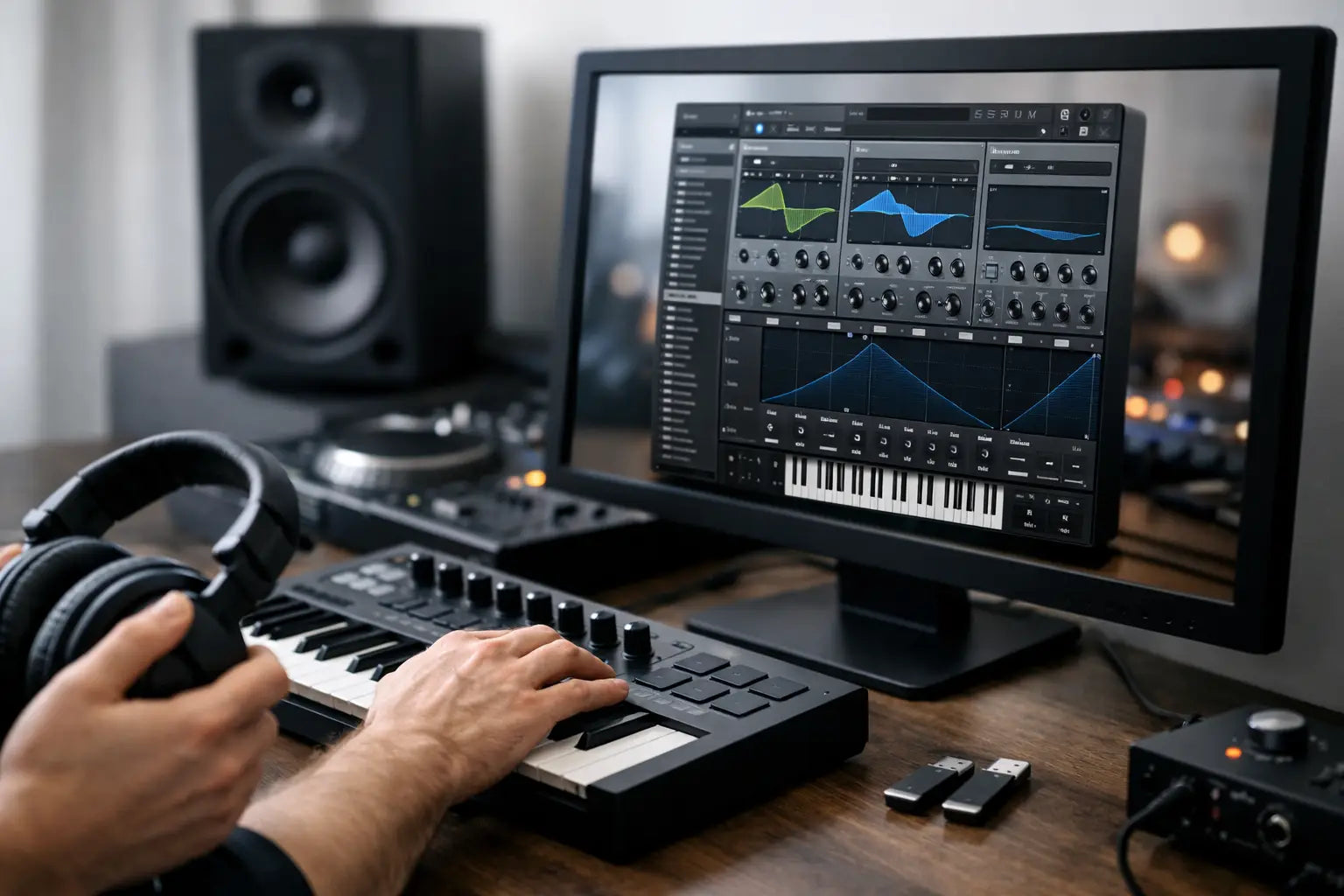
A great preset should make you want to write the next eight bars immediately. A bad one can sound impressive in isolation, then disappear under the drums, fight the vocal, or pull your track toward the wrong genre. This serum presets buying guide is built for producers who want club-ready sounds that create momentum fast, not another folder of patches they will never use.
The right Serum pack is not necessarily the one with the highest preset count. It is the one with sounds that fit your production style, work inside a real arrangement, and give you enough control to make the record feel like yours.
Start With the Genre You Actually Produce
Electronic subgenres share tools, but they do not share the same low-end language, movement, or mix space. A Tech House bass preset needs a different role than a Melodic Techno bass. One is often dry, direct, and rhythm-led. The other may need sustained character, stereo width above the sub range, and evolving harmonic motion.
Before buying, look at the genre promise of the pack and ask whether it matches the records you are finishing right now. If you make Afro House, prioritize warm plucks, organic percussion-inspired tonal layers, deep but controlled basses, and musical leads that support groove without becoming overly aggressive. For Techno, you may get more value from driving sequences, industrial stabs, rumble-ready bass tones, tension risers, and darker atmospheres.
EDM and Bass House producers may need punchier supersaws, high-impact leads, distorted basses, and aggressive fills. Melodic Techno producers often benefit from arps, emotional chords, cinematic textures, and basses that carry energy without crowding the kick. Buying across genres can spark fresh ideas, but it should be intentional. A preset pack designed around a sound you do not use is rarely a shortcut.
Listen for Function, Not Just Flash
Preview clips are designed to catch your ear, but your question should be practical: what job will this sound do in my next track? A useful preset collection usually covers clear production roles, such as basses, leads, plucks, pads, arps, chords, sequences, FX, and drums or percussion-derived tonal sounds.
A huge lead with delay and reverb can sound cinematic in a demo. In your session, it may need to be reduced, widened differently, or replaced once the vocal arrives. That does not make it a poor preset. It means the pack should give you enough variety to choose sounds by arrangement role, not just by immediate excitement.
What to Look for in a Serum Presets Buying Guide
The strongest Serum preset packs are designed with a producer's full workflow in mind. They should sound polished from the first note while leaving enough room for your own chord choices, processing, and automation.
First, check the sound design quality. Listen for basses with a focused low end rather than uncontrolled mud, leads that hold their place in the midrange, and pads that create width without hollowing out the center of the mix. Presets should have character, but they should not require a rescue mission before they work in a track.
Second, look for macro control. Well-programmed macros turn a preset into a performance tool. They may open the filter, introduce distortion, change wavetable position, increase reverb, add movement, or shift the sound from restrained to peak-time. This matters because club records need evolution. A static four-bar loop rarely stays interesting for six minutes.
Third, consider how the pack is organized. Clear naming by category and sound type saves time when inspiration is moving. If you are searching for a tight offbeat bass, a rolling sequence, or a tension-building FX patch, you should not have to audition 100 random presets to find it.
Finally, check whether the pack includes the Serum version and any requirements you need to load the presets correctly. Compatibility is basic, but it is still worth verifying before checkout. A strong preset is only useful if it opens as intended in your setup.
Prioritize Mix-Ready, Not Over-Processed
There is a difference between a preset that sounds finished and one that is overloaded with effects. For modern club music, you want a sound that feels expensive, wide, and energetic while still giving your kick, bass, percussion, and vocal room to work.
Basses deserve the closest attention. A preset can have a massive sub in headphones, but a competing sub layer may create phase problems with your kick. Look for packs with basses that are controlled and easy to shape. You should be able to high-pass or low-pass where needed, add saturation, and sidechain without the entire patch losing its identity.
The same principle applies to leads and pads. Heavy reverb may make a preset feel larger in a product demo, but you need flexibility once it enters a dense drop or breakdown. Presets with sensible effects settings and useful macros let you decide how much space the final arrangement can afford.
If you are newer to mixing, mix-ready presets can speed up your learning curve. If you already have a defined processing chain, slightly cleaner presets may be the better buy. It depends on whether you want instant impact or a more neutral starting point for your own sound design.
Check Whether the Pack Supports Real Arrangement Work
A preset purchase should help you finish records, not just create satisfying loops. The best collections include sounds for multiple moments of a track: understated opening textures, groove-focused main elements, breakdown emotion, transition energy, and peak-time impact.
For example, a Tech House project may need a short bass, a percussive synth stab, a vocal-style lead, a rolling arp, and FX that help the arrangement breathe. A Melodic Techno project may need evolving pads, a powerful but restrained bass, a central hook, a filtered sequence, and tension tools for long transitions.
When evaluating a product, think in terms of a complete record rather than one hero sound. A pack with 50 carefully selected presets that work together can be more valuable than 200 unrelated patches. Cohesion helps you build a recognizable sonic world quickly.
Use Presets as Starting Points, Not Finished Identities
Buying presets does not mean your tracks will sound like everyone else's. It means you are beginning with a professional foundation instead of building every oscillator, envelope, filter, and effects chain from zero.
Make each patch your own with small, high-impact moves. Change the MIDI rhythm, alter the octave, automate a macro through the build, swap the wavetable position, or layer the preset with a one-shot texture. Even changing the velocity pattern can turn a familiar pluck into something more human and groove-focused.
The goal is speed with authorship. You are saving time on the technical groundwork so you can spend more of it on selection, arrangement, tension, and musical decisions.
Decide Between Single Packs, Bundles, and Free Sounds
Your buying choice should reflect where you are in production. If you are working on a specific track or genre, a focused pack is often the smartest move. You get a clear palette and fewer distractions.
Bundles make more sense when you are building a deeper library across several related styles. They can be especially useful for producers who regularly move between Tech House, Afro House, Melodic Techno, and EDM, or who want preset options for multiple projects without shopping every week.
Free samples and free presets are useful for testing a brand's sound design approach. They can show you whether the programming, tonal balance, and genre direction fit your workflow. But do not judge a complete premium collection solely by a small free selection. A dedicated pack usually offers more depth, consistency, and arrangement-ready variety.
Hot Grooves builds Serum presets around the sounds producers need in current club-focused productions: direct, polished, and designed to get ideas moving without slowing down the session.
A Quick Pre-Buy Checklist
Before adding a Serum preset pack to your library, make sure it answers these five questions:
- Does it match the genre and references I am producing now?
- Are there sounds for different arrangement roles, not just big leads?
- Do the presets have useful macros and room for customization?
- Does the low end sound controlled enough for a kick-and-bass workflow?
- Is the preset count focused on quality and usable variety rather than filler?
Commercial Use Sample Packs: What to Check First
Can You Release Songs With Loops? Know the Rules