
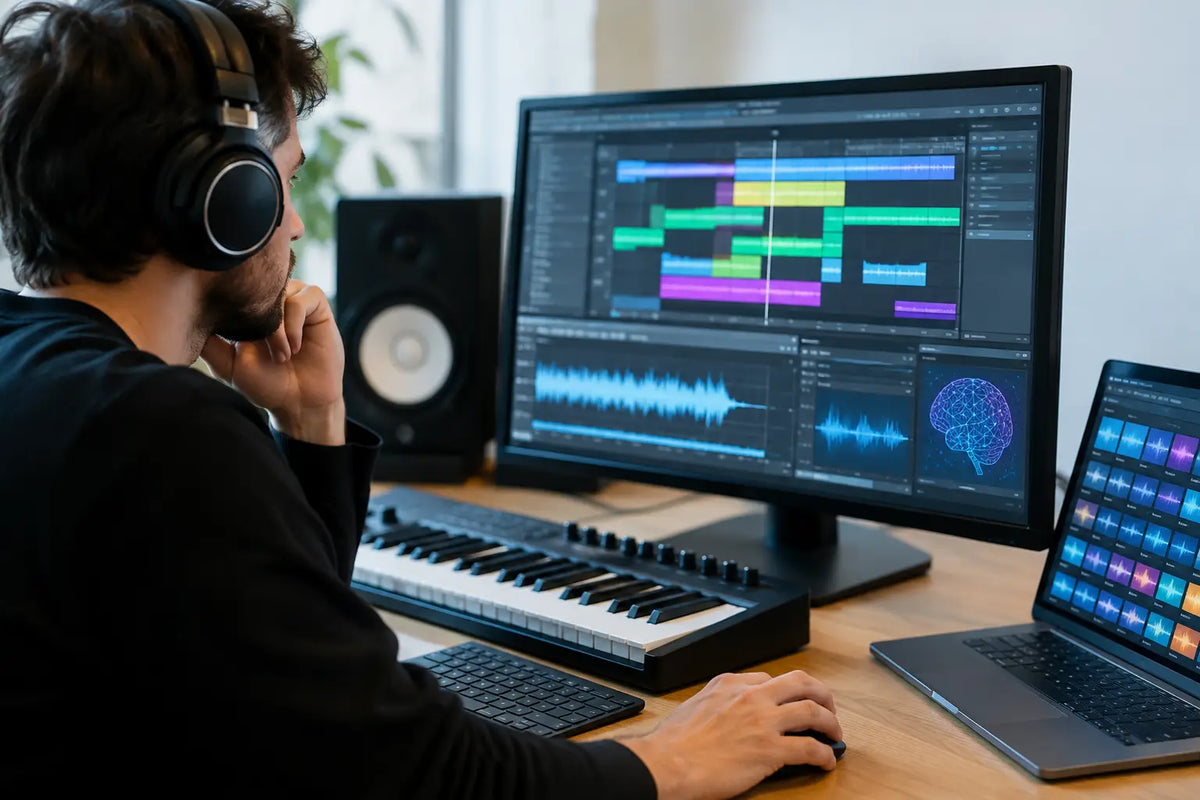
A great club track can stall on one small decision: the kick has weight but no character, the vocal chop feels generic, or the percussion loop brings energy without the right swing. AI assisted sampling can shorten that gap between an idea and a usable arrangement. Used well, it helps you search, sort, transform, and combine sounds faster. It does not replace your taste, your groove, or the final call on what belongs in the track.
For producers working in Afro House, Tech House, Melodic Techno, Techno, Bass House, and EDM, the practical value is simple: less time scrolling through folders and repairing weak source material, more time building tension, movement, and a mix that holds up on a serious system.
What AI Assisted Sampling Means in Production
AI assisted sampling is not one button that makes a finished track. It is a set of tools and workflows that use machine learning to help identify a sound, suggest related material, separate audio elements, detect key or tempo, generate variations, clean up recordings, or organize a growing sample library.
The distinction matters. A sampled sound becomes useful because of context. A tom loop that sounds perfect in a browser may fight your kick once the bass arrives. An AI tool can identify its BPM, find similar loops, or produce alternate patterns. It cannot reliably decide whether that loop creates the right push into your drop. That is still production.
The strongest workflow treats AI as an assistant at the source-selection stage, not as a substitute for musical direction. Start with a clear brief: dark tribal percussion at 122 BPM, a dry spoken phrase for a Tech House break, or a metallic impact that can mark a Melodic Techno transition. Specific inputs produce faster, more relevant results.
Where AI Saves the Most Time
The biggest win is library management. Most producers own far more samples than they can remember. Files are scattered across old drives, pack folders, bounced projects, and desktop downloads. AI-powered tagging and similarity search can make that collection usable again.
Instead of opening every folder labeled “Perc 03,” you can search by a practical need: shakers with a loose groove, deep house-style congas, short noisy risers, or an F# minor vocal texture. The result is not automatically the right sound, but it narrows a forty-minute hunt to a few focused auditions.
Key, tempo, and transient detection can also remove repetitive setup work. This is especially useful when you are building quickly from loops, vocal phrases, and recorded percussion. Correct analysis lets you audition material in the project context sooner. Still, check it by ear. Complex vocals, swung percussion, and sounds with weak pitch information can be analyzed incorrectly.
Audio separation is another useful lane. You may want to pull a vocal phrase away from a recording, isolate percussion from a field capture, or extract a texture for resampling. The cleaner the source, the better the result. Separation artifacts can be creative in a breakdown or transition, but they are rarely ideal for an exposed lead vocal.
Build a Faster Sampling Workflow
Start with the track, not the technology. Before searching for anything, establish the tempo, key center, and the role the sample needs to play. Is it driving the groove, filling the top end, creating atmosphere, or giving the listener a memorable hook? A clear role prevents you from collecting ten options when you only need one decisive sound.
Next, use AI search or tagging to create a short candidate pool. Keep it tight. Audition three to five loops or one-shots against the core drums and bass, not in solo. The best sample is the one that works with the record, even if it sounds less impressive alone.
Then commit to transformation. Chop a loop into a new rhythm, reverse a tail, pitch a vocal fragment, layer a one-shot underneath, or resample the part through saturation and filtering. This is where generic source material becomes yours. For club music, small changes often make the difference: a shifted clap, a shortened shaker tail, a vocal chop placed one eighth-note later.
Finally, print or bounce your selected variation and label it clearly. Your future self should be able to find “Afro perc fill 123 Fm processed” without opening the project. Smart organization is not glamorous, but it keeps creative momentum from disappearing into file management.
Use AI for Options, Not Endless Options
There is a trap in fast search: abundance can slow you down. If an assistant can surface 200 related sounds in seconds, it is easy to keep auditioning instead of arranging. Put a limit on the search. Once you have a workable choice, move it into the track and test it over eight or sixteen bars.
The same applies to AI-generated variations. Generate a few, choose one direction, and edit it manually. A dance floor does not reward the number of options you reviewed. It responds to a groove that feels intentional.
AI Sampling Still Needs Strong Source Material
AI can improve access to sounds, but it cannot make poor recording, weak sound design, or unclear licensing disappear. Starting with properly produced, genre-specific royalty-free samples gives you more usable results and fewer problems later.
That is why curated packs remain valuable. A well-designed percussion loop has controlled transients, sensible headroom, and a groove that sits naturally at its intended tempo range. A vocal collection includes phrases that can be chopped, pitched, and processed without falling apart. A Serum preset provides a sound that already understands its place in a modern electronic arrangement.
At Hot Grooves, that producer-first approach matters because speed only helps when the source is ready to perform. AI can help you find a rolling Afro House shaker or a tight Tech House drum hit faster, but a focused library gives it better material to work with from the start.
Protect Originality and Your Release Rights
There are two separate questions around AI assisted sampling: does it sound original, and can you legally use it? Do not treat them as the same issue.
A royalty-free sample can be legally cleared under its license yet still sound familiar if you use it untouched in a prominent moment. Conversely, a heavily processed recording can feel unique but still create rights issues if you do not have permission to use the original source. Always know where your audio came from and what the license allows.
Be especially careful with tools trained on unclear audio sources or tools that generate material designed to imitate a recognizable artist, voice, or released recording. If you cannot verify the source terms, do not build the identity of your track around it. For commercial releases, DJ promos, and client work, certainty is worth more than a quick shortcut.
Originality comes from decisions across the arrangement. Layer a familiar clap with a quieter foley hit. Turn one vocal word into a rhythmic motif. Re-pitch percussion to follow harmonic movement. Automate filtering so a texture develops with the energy of the section. Those choices create identity without making the workflow slow.
Make the Final Decision in the Mix
AI recommendations are often based on sonic similarity, metadata, or broad genre patterns. Your mix has more specific demands. A suggested bass sample may share the right key and style, but it can still crowd the fundamental of your kick. A bright hat loop may match the BPM while making the drop brittle at high volume.
Check your choices in context at realistic monitoring levels. Pay attention to low-end overlap, stereo width, transient density, and what happens when the arrangement reaches its busiest point. If a sample only works after extreme EQ and processing, it may be the wrong choice. Replace it before you spend an hour trying to force it into place.
Use AI to reduce friction, not to hand over authorship. The best result is a faster path to a track that sounds like you made every call on purpose. When the groove is locked, the source sounds are strong, and the arrangement has a clear point of view, the listener will never care how quickly you found the first sample.
EDM Production Trends Defining Club Tracks
Are Free Sample Packs Worth It for Producers?