
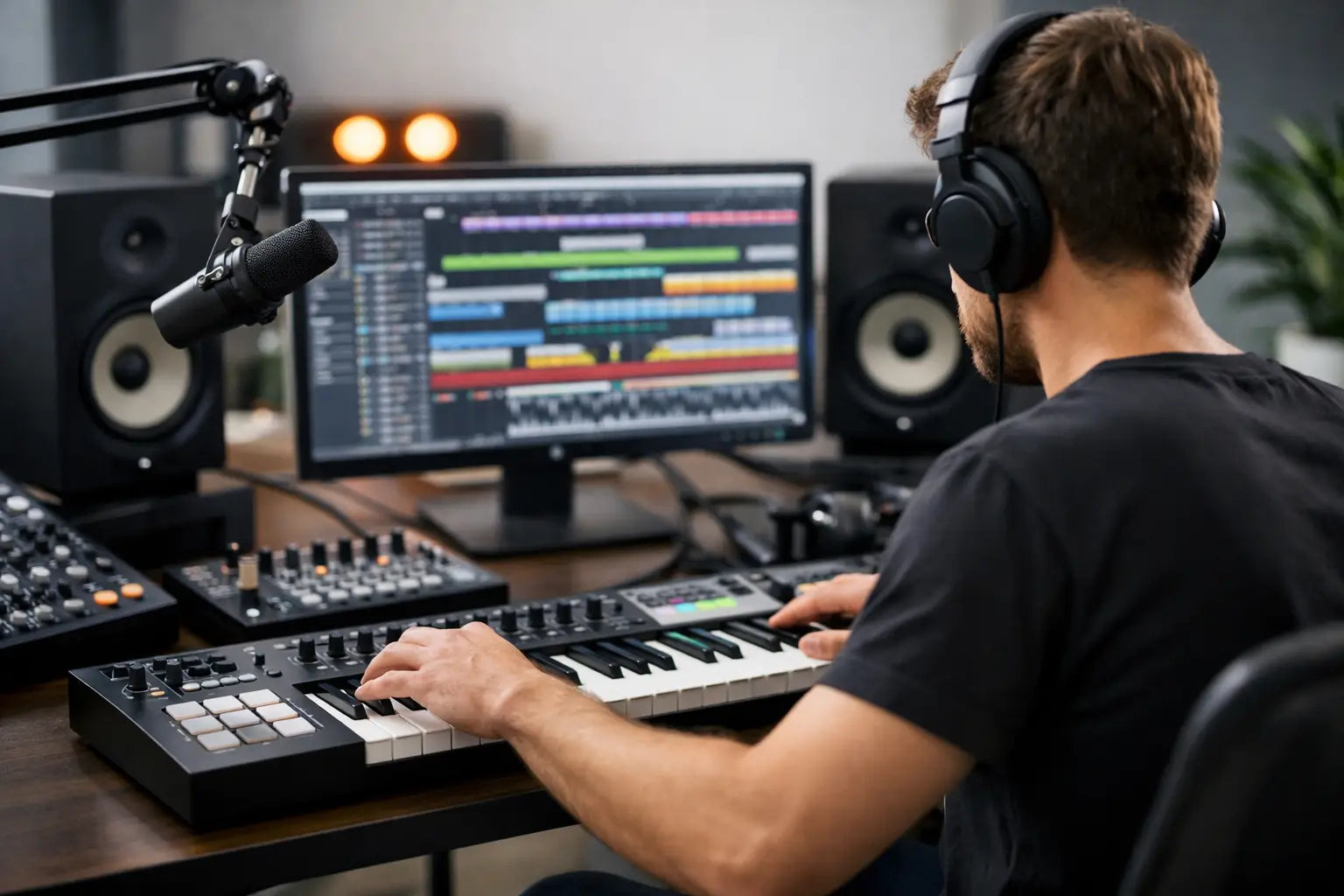
The fastest producers are not always the most talented. They are usually the ones making fewer unnecessary decisions. That is the real advantage of a strong electronic music producer workflow - less time digging through folders, rebuilding the same drum chain, or tweaking a bass patch for an hour, and more time finishing records that actually hit.
For club-focused producers, workflow is not some soft productivity topic. It directly affects groove, mix quality, and output. If your session gets messy, your ideas lose momentum. If your sound selection takes too long, the track starts to feel forced. And if every project begins from zero, finishing consistently becomes much harder than it needs to be.
What an electronic music producer workflow should actually do
A good workflow should reduce friction without boxing you in. That balance matters. If your process is too loose, you waste time chasing options. If it is too rigid, every track starts to sound like the last one.
The goal is simple: create a repeatable system that gets you from idea to arrangement to final polish with less second-guessing. For electronic music, that usually means organizing sounds by genre, building reliable templates, deciding faster on drums and bass, and separating creative work from technical cleanup.
This is especially true in styles like Afro House, Tech House, Melodic Techno, Bass House, and EDM, where sound choice carries a lot of the record. A kick that fits immediately, a percussion loop with the right movement, or a preset that already sits in the pocket can save you an entire hour.
Start with source sounds, not endless options
Most workflow problems begin before the first note is written. Producers open a blank session, then start scrolling through thousands of random samples and presets with no clear direction. That is not creativity. That is friction disguised as freedom.
A better move is to build a smaller working library around the genres you actually produce. If you make Tech House, you do not need cinematic drums, vintage boom bap snares, and fifty ambient texture folders cluttering your session. You need kicks, tops, percussion, bass one-shots, vocal chops, FX, and synth presets that already speak the language of the genre.
This is where curated packs matter. Good sample packs are not just about having more sounds. They are about reducing bad choices. When your library is built around current, club-ready material, your decisions get faster because fewer sounds need fixing.
That does not mean every track should rely on drag-and-drop loops. It means your starting points should already be high quality. You can still chop, layer, automate, distort, resample, and make the result your own. Workflow improves when the raw material is already strong.
Build a template that speeds up the right things
Templates save time, but only if they solve real production bottlenecks. A bloated template with twenty inactive tracks, ten mastering plugins, and color coding for things you never use can slow you down just as much as starting fresh.
Keep your template focused on the parts of production you repeat in every session. For most electronic producers, that means a basic drum bus, a bass channel, a music bus, a vocal bus if needed, return tracks for delay and reverb, and a clean routing structure. Have your gain staging, basic bus processing, and a few trusted metering tools ready to go.
You should also have a few MIDI and instrument starting points loaded if they are genuinely useful. Maybe that is a sub bass channel, a chord stab synth, or a Serum instance with macro mapping already set. The key word is useful. If it does not help you get to a first groove faster, it does not belong there.
Split writing, sound design, and mixing into separate phases
One of the biggest workflow killers is trying to do everything at once. You start a beat, then suddenly you are tuning compressor release times on the master bus, replacing hi-hats, redesigning the bass patch, and fixing a vocal that does not even belong in the drop yet.
That usually leads to half-finished tracks and weak creative momentum.
A stronger electronic music producer workflow separates phases. In the writing stage, focus on groove, hook, energy, and arrangement direction. Get the core record working first. If the track does not move with basic sounds, extra polishing will not save it.
Then shift into sound refinement. Swap in stronger samples, improve synth patches, tighten transitions, and add movement. After that, move into mix decisions with a cleaner head. This structure is not rigid law, but it keeps you from solving problems out of order.
Some producers blur these stages naturally, and that can work. But if you regularly stall out, phase separation is one of the fastest fixes.
Make drums the decision center
In club music, drums are usually where the track either locks in or falls apart. That is why workflow around drum selection matters so much. If you spend too long rebuilding your rhythm section, the rest of the production gets delayed.
Start with the groove backbone first - usually kick, clap or snare, closed hats, and one or two key percussion elements. Once that pocket is right, everything else becomes easier to judge. Bass placement, vocal rhythm, and synth sync all respond better when the drums already feel credible.
Avoid over-layering early. Producers often stack five hats, four claps, and multiple percussion loops before checking whether the groove even works. Usually one great hat and one well-chosen shaker loop will outperform a pile of average layers.
The same applies to drum processing. Use enough to shape, not enough to flatten. Club drums need impact and movement. If every channel is heavily saturated and compressed from the start, you lose contrast fast.
Use presets and loops as production accelerators, not crutches
There is still a weird stigma around using presets, loops, and one-shots, even though a huge amount of modern electronic music relies on them in some form. The real question is not whether you used a preset. It is whether you made strong production decisions with it.
A preset that gives you the right tonal character in ten seconds is a workflow advantage. A percussion loop that instantly fills the top-end rhythm is a workflow advantage. A vocal phrase that sparks the whole track idea is a workflow advantage.
The smart move is to treat these elements as fast foundations. Adjust MIDI, edit transients, automate filter movement, layer selectively, and reprocess with intention. Producer-built tools from sources like Hot Grooves are valuable because they are designed around current genre expectations, which means less rescue work later in the mix.
Create a finish-first arrangement habit
A lot of producers are good at making eight-bar loops. Fewer are good at turning them into records that DJs can actually play.
That gap is usually a workflow issue, not just a talent issue.
Once your main groove is working, move into arrangement before you over-perfect the loop. Block out the intro, first section, buildup, drop, break, and outro. Keep it rough if needed, but get the full structure on the timeline. A complete average arrangement is easier to improve than an amazing unfinished loop.
Reference your genre honestly here. Tech House wants a different energy curve than Melodic Techno. Afro House often depends more on evolving percussion and hypnotic movement. Bass House may need quicker impact and bolder switch-ups. Workflow gets better when your arrangement habits reflect the records you actually want to compete with.
Reduce revision fatigue with a simple file system
A messy archive slows everything down. If your exports are named Final 2, Final 2 New, Final Real Final, and Mixdown Test 7, you are adding friction for no reason.
Use a naming system that tells you the track title, version, and date. Keep project folders consistent with stems, exports, references, and bounce files in the same structure every time. Save presets, racks, and effect chains you actually reuse. Archive old ideas, but do not let them pollute your main working folders.
This is not glamorous, but it matters. Clean file management saves mental energy, and mental energy is a production asset.
Know when speed helps and when it hurts
Faster is not always better. Some ideas need room. Some records need custom sound design, unusual automation, or more detailed arrangement work. Workflow should help you reach quality faster, not rush you into generic output.
The right approach depends on the track. A DJ tool may come together quickly from strong drums, a bass groove, and a vocal hook. A more melodic or cinematic record may need slower development. What matters is recognizing where speed creates momentum and where patience improves the result.
The producers who finish consistently are rarely doing magic. They are protecting their attention, limiting weak choices, and building sessions around sounds that already belong in the lane.
If your workflow feels heavy, do not try to fix it with more plugins or more folders. Tighten your source material, simplify your template, and make decisions earlier. The track usually tells you what it needs once the noise is out of the way.
Why Use Sample Bundles for Better Tracks
Can You Release Songs Using Samples?