
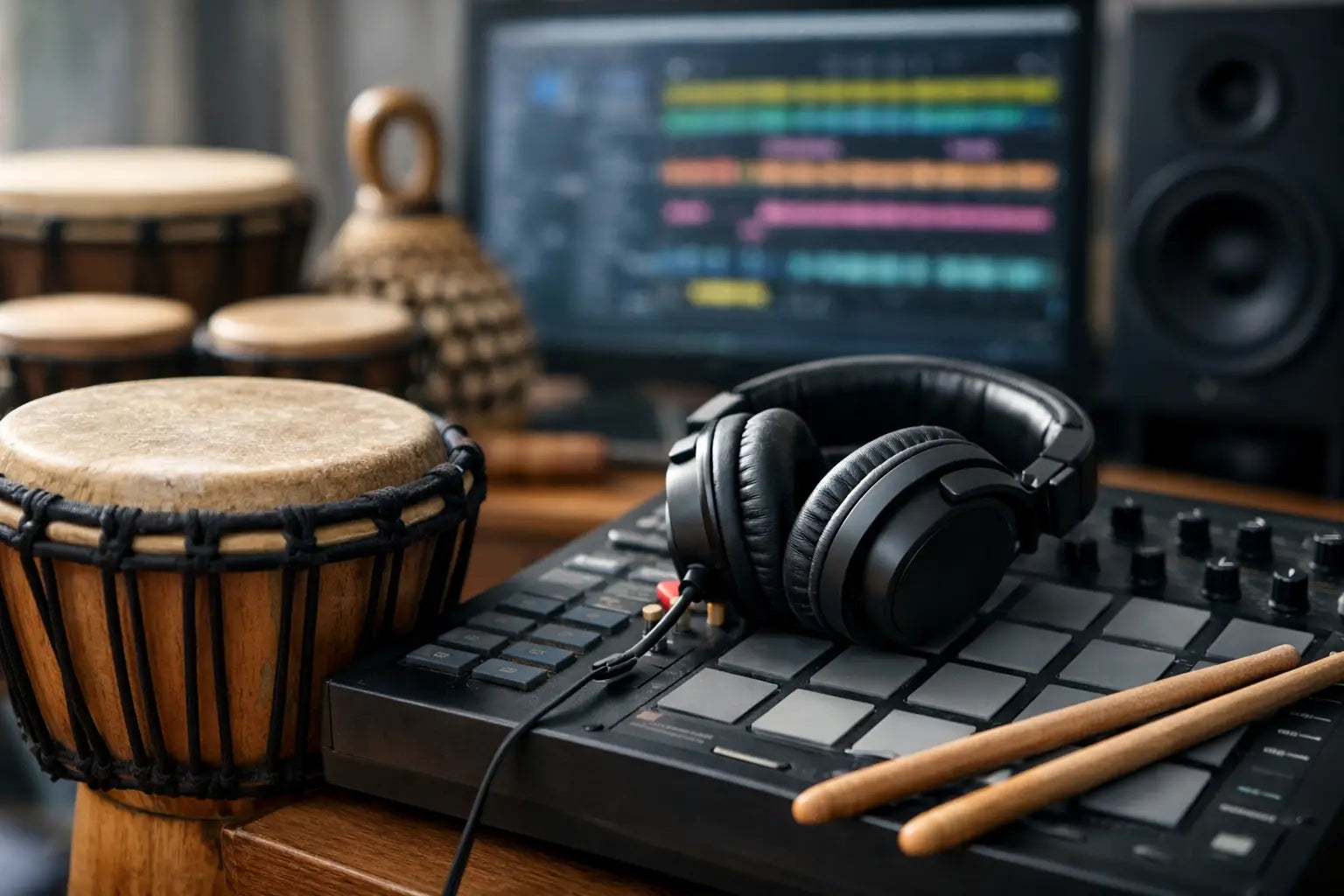
A lot of producers get the kick right, add a shaker loop, throw in some toms, and still miss the point. If you want to learn how to build afro house drums, the real job is not stacking more percussion. It is creating movement that feels human, hypnotic, and strong enough to carry the track for six minutes without getting flat.
Afro House drums are deceptively simple when you solo the parts. The magic shows up in the relationship between the kick, the rolling low percussion, the off-grid hats, and the call-and-response happening in the mids. That is why a clean groove with the right sound choices will beat a crowded drum rack almost every time.
How to build afro house drums from the groove up
Start with the groove before you worry about the mix. Producers often do the opposite because it feels productive to EQ, saturate, and compress early. But if the rhythm is not pulling you forward on a basic loop, no amount of processing will turn it into a convincing Afro House section.
The kick is your anchor. In most Afro House, you want a kick that feels deep, rounded, and controlled rather than aggressively clicky. It still needs enough top-end definition to translate on smaller systems, but the sub and low mids should carry the weight. If the kick feels too short, the groove can lose authority. If it feels too long, it can smear against the bass and low percussion. There is no fixed setting here - the right decay depends on tempo, bass pattern, and how busy your percussion layer is.
Once the kick is in place, build a low percussion pocket around it. This is where many tracks start sounding generic. Instead of reaching for random tribal loops, use one or two parts with a clear rhythmic purpose. A muted tom, conga, or low hand drum can create forward motion between the kick hits. You are not trying to fill every gap. You are trying to create tension and release inside a repeating bar.
A useful test is to mute everything except kick and low percussion. If that loop already feels like it could carry a dance floor, you are on the right path. If it sounds stiff, the answer is usually timing and velocity, not more layers.
Program rhythm, not just hits
Afro House lives in the micro-groove. Straight quantization can work for some top loops, but the core percussion usually benefits from slight offsets. Push one hit a little late, pull another slightly forward, and vary the velocity so the pattern breathes. Small changes matter more than dramatic swing settings.
Think in phrases of one or two bars. A single conga hit landing differently at the end of bar two can stop the loop from feeling mechanical. That kind of variation is subtle enough for club music but strong enough to keep repetition interesting.
This is also why dragging in a full loop and leaving it untouched often falls short. Pre-made loops can sound great, but if they are not interacting with your kick pattern and bass movement, they will sit on top of the track instead of driving it.
The core layers that make Afro House drums work
Most strong Afro House drum sections are built from a few reliable elements. The kick provides weight. Low percussion adds body and movement. Mid percussion creates identity. Hats and shakers add momentum. Then a small amount of ear candy or transient detail keeps the loop alive.
The mistake is treating each layer like it needs to be impressive on its own. In a finished groove, every element should leave room for the others. That means choosing sounds with different frequency centers and different envelope shapes.
Your mid percussion is where character starts showing up. Congas, bongos, rim-style hits, wooden percussion, claps with texture, and tuned hand drums can all work. What matters is contrast. If every hit is bright and snappy, the loop gets tiring fast. If everything is soft and dark, it can feel unfinished. You need a balance between attack and warmth.
Top-end motion usually comes from hats or shakers, but they should not dominate the groove. In a lot of weaker productions, the shaker becomes a blanket of noise. That can make the track feel busy without adding actual energy. A better move is using one main top loop with a clear rhythm, then adding a second lighter layer only when the arrangement needs lift.
Choose fewer sounds, better sounds
Sound selection saves more time than repair work later. If your percussion samples already sound polished, dynamic, and genre-accurate, the groove comes together faster and needs less processing. That is one reason producers lean on specialized libraries instead of building every hit from scratch. Hot Grooves, for example, is built around that exact workflow advantage - getting to a release-ready groove without losing hours fixing weak source material.
That said, good source sounds still need editing. Trim the tails, tune the drums if needed, and make sure each sample earns its place. If two percussion hits are fighting for the same frequency range and rhythmic role, keep the better one.
How to build afro house drums that feel bigger without sounding crowded
Bigger is not the same as more layered. The biggest Afro House drum grooves often feel spacious because each element has a defined job. You hear the weight of the kick, the pocket of the low percussion, the push of the shaker, and the personality of the mids without any one part swallowing the mix.
Start with volume before plugins. If the loop does not feel balanced with simple level moves, processing will only hide the problem. Bring the kick up first, set the low percussion so it supports rather than competes, and then bring in the mids and highs around that foundation.
Panning helps, but it needs restraint. A little width on shakers, metallic tops, or supporting percussion can open the groove nicely. The core pulse should still feel centered and solid. If your most important rhythmic cues are too wide, the drums can lose impact in mono and feel less focused on a club system.
Transient shaping can be useful when a drum has the right tone but the wrong envelope. A soft conga may need a little more attack to cut through. A sharp hat may need less spike so it sits inside the groove. Saturation also helps, especially on percussion buses, because it can add density without relying on harsh EQ boosts. But these moves work best when they are small. Afro House drums should feel alive, not over-processed.
Keep low-end clarity
The relationship between the kick, bass, and low percussion is where a lot of mixes fall apart. If your toms or hand drums carry too much sub information, they will cloud the foundation. High-pass what does not need true low-end weight, and be careful with long resonances.
Tuning matters here more than many producers realize. If a low drum is ringing in a way that clashes with the key center or the bass note, the whole groove can feel muddy even when the levels look fine. A small pitch adjustment can clean up the loop faster than another EQ band.
Arrangement is part of the drum design
A great four-bar loop is not enough. Afro House relies on evolution. The drums need to shift in ways that feel natural, not obviously automated. That usually means introducing and removing layers, changing velocities, or swapping one percussion phrase at transition points.
Instead of throwing in a big snare roll every eight bars, try taking elements away. Dropping the shaker for four beats before a section change can create more tension than adding another riser. Bringing in a new hand percussion accent only in the second half of a phrase can make the groove feel like it is opening up.
This style rewards patience. Let the rhythm establish itself before you ask it to do more. If the drums are already telling a strong story, your arrangement choices can stay minimal and still feel effective.
Common mistakes that kill the groove
The first is over-quantizing. Perfect timing can strip the life out of percussion-heavy music. The second is over-layering. Too many loops create confusion, especially when they all have similar transients. The third is over-brightening. Harsh tops may sound exciting for 20 seconds but become fatiguing fast.
Another common issue is copying a pattern visually instead of listening to the pocket. Afro House is not about how dense the MIDI looks. It is about where the energy lands and how the empty space supports it.
Build for the club, not just the laptop
When you are finishing your drum section, test it at different playback levels. At low volume, the groove should still feel clear and intentional. At higher volume, it should feel physical without turning brittle. If the loop only works when it is loud, there is probably a balance problem hiding in the midrange or top-end.
Also pay attention to repetition fatigue. A groove that feels exciting on first listen may get annoying by the third minute if the shaker is too sharp or the percussion pattern is too crowded. Club-ready drums need stamina. They should hold attention over time, not demand it every second.
The fastest way to improve is to stop treating drums like background support. In Afro House, they are often the main event. Build the groove so it can stand on its own, and the rest of the track has something real to lock into.
The best drum sections do not sound busy or forced. They sound inevitable, like every hit landed exactly where it needed to. That is the target.
Best Free Sample Packs for Producers
10 Best Royalty Free Vocal Collections