
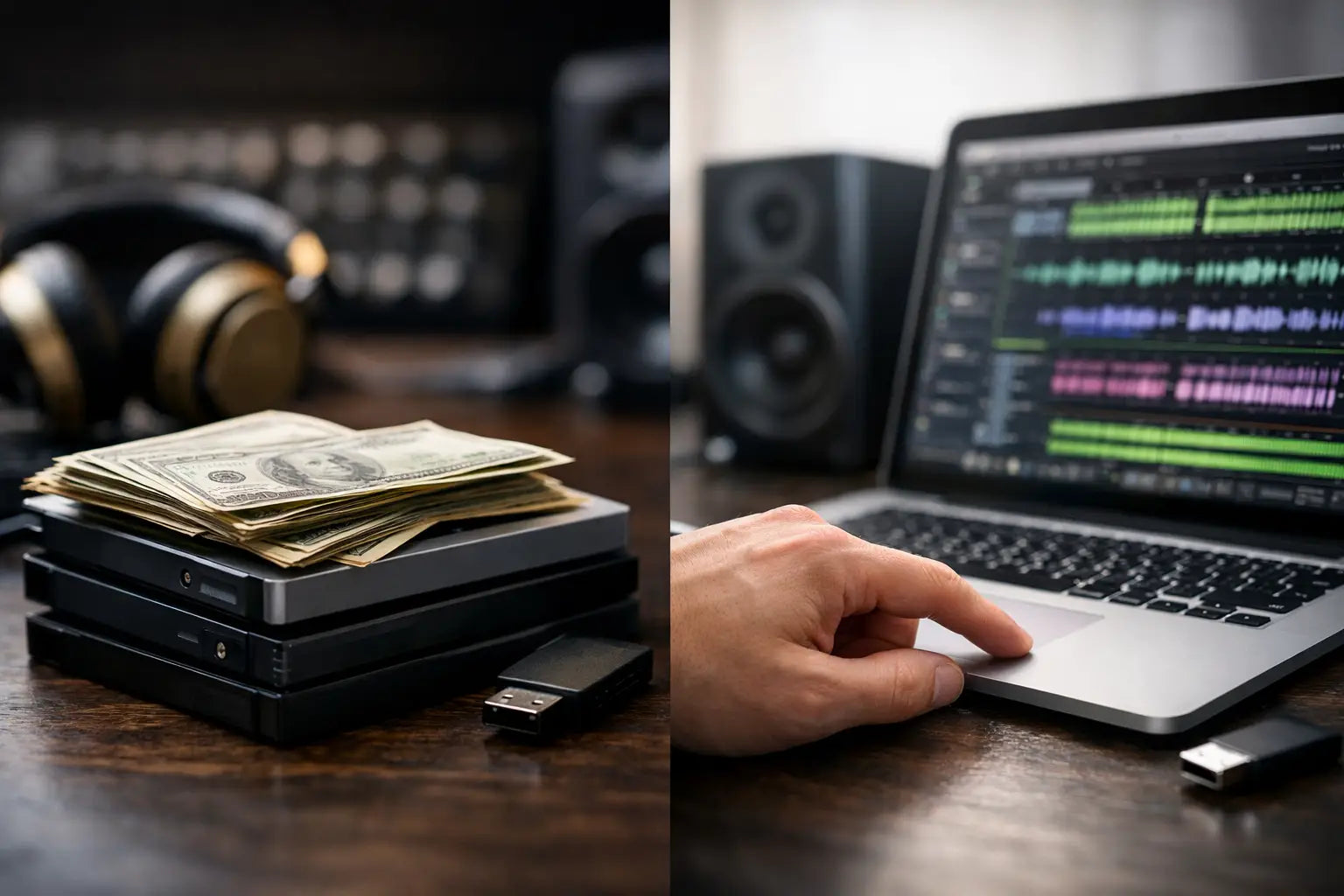
A free loop can spark a track in five minutes. It can also leave you hunting for matching drums, bass, and variations two hours later. That is the real question behind paid samples vs free downloads: not which option costs less upfront, but which one gets your production closer to the finish line.
For electronic producers, source sounds affect more than inspiration. They shape arrangement speed, mix decisions, genre authenticity, and whether a drop lands with the weight expected in a modern club record. Free downloads and premium sample packs both have a place in a serious workflow. The smart move is knowing what each is designed to do.
Paid Samples vs Free Downloads: The Core Difference
Free downloads are usually built for discovery. They let you test a label's sound, explore a new genre, fill a small gap in your library, or grab an idea when you need it fast. A strong free pack can introduce a new vocal texture, a fresh percussion flavor, or a Serum preset that changes the direction of a session.
Paid packs are built for depth and consistency. Instead of one good loop surrounded by unrelated files, a premium collection is typically designed as a complete production toolkit. The kicks, tops, bass loops, synths, vocals, MIDI, and presets are made to work within the same sonic world. That matters when you are building a full Afro House groove, a tight Tech House roller, or a Melodic Techno arrangement that needs movement from the intro through the final drop.
The difference is not that free sounds are automatically bad and paid sounds are automatically great. There are excellent free samples and weak premium products. The practical distinction is curation. A paid, genre-focused pack should reduce the time between opening your DAW and making decisions you can trust.
When Free Downloads Make Sense
Free samples earn their place when you are experimenting. If you are new to Bass House, for example, downloading a small collection of bass shots or drum loops is a low-risk way to learn the genre's energy before investing in a larger toolkit. The same applies when you want to audition a producer's sound design style or see how a pack label organizes files.
They are also useful for breaking routine. Producers who rely on the same drum folder for every project can use a free download as a creative interruption. One processed clap, an unusual vocal chop, or a different percussion loop may be enough to get a stale eight-bar idea moving again.
Free content works best when the requirement is narrow. You need one riser, a handful of fills, a new shaker, or a few presets to audition. It is less effective when you need to build a cohesive record under a deadline. A collection of random downloads often creates more browsing than producing, especially if file names, key labels, tempos, and recording quality are inconsistent.
There is another factor: availability. Free offers can be limited, promotional, or designed as a small preview rather than a complete sound library. Treat them as a useful entry point, not a production plan.
Why Paid Packs Can Save More Than They Cost
The price of a sample pack is easy to see. The cost of lost momentum is not. If you spend an evening layering five weak kicks, correcting an out-of-key vocal, or trying to force a loop into a genre it was not made for, the “free” option has become expensive in studio time.
A well-made paid pack gives you options that belong together. You can audition a kick with compatible percussion, pair a bass loop with an appropriate top loop, and find fills that maintain the same character across transitions. That cohesion makes arrangement faster because you are selecting from a deliberate palette instead of repairing mismatched sounds.
For producers aiming at release-ready music, paid collections can also provide the details that separate a sketch from a finished record. Think layered drum construction kits, dry and processed variations, clean one-shots, usable vocal phrases, and presets that already sit in the tonal territory of the genre. You still need taste, arrangement skills, and mix judgment. But you are no longer starting every sound from zero.
This is especially valuable in club-focused genres, where the standard is specific. A Tech House kick needs a different relationship with the bass than a rolling Afro House groove. A Melodic Techno lead needs enough character to carry emotional tension without overcrowding the mix. Purpose-built samples help you make those decisions from a stronger starting point.
You Are Paying for Selection, Not Just File Count
Big file counts can look impressive, but a pack with 2,000 generic sounds is not automatically more useful than a focused collection of 250 excellent ones. The best value comes from sounds you will actually reach for repeatedly.
Before buying, look beyond the number of files. Check whether the pack clearly identifies its genre, formats, BPM ranges, key information, and included content. Consider whether it offers the elements you use most: loops for speed, one-shots for custom programming, vocals for hooks, MIDI for harmonic ideas, or Serum presets for sound design flexibility.
A producer making peak-time Techno may not need another broad “EDM” library. They may need driving percussion, rumbling low-end tools, atmospheric textures, and synth presets designed for tension. Specificity is often a better indicator of value than quantity.
The License Matters as Much as the Sound
Royalty-free does not mean every use case is identical. Read the license terms before releasing music, submitting tracks to labels, using sounds in client work, or building content for monetized channels. Most reputable royalty-free sample packs allow you to use sounds in your own musical productions, but they do not allow you to resell, redistribute, or upload the raw files as your own sample library.
Pay special attention to vocals. A vocal phrase may be royalty-free for use in a track, yet still require thoughtful treatment so your release has its own identity. Chop it, pitch it, layer it, resample it, or build a new context around it. That approach is creatively stronger and helps your music avoid sounding like a straight demo of the source material.
Keep your purchase records and pack documentation organized. It is a small habit that makes distribution questions, label conversations, and future project recalls much easier.
Build a Hybrid Sample Strategy
You do not have to choose one side permanently. A productive library usually combines premium core tools with selective free additions.
Use paid packs as your foundation for the genres you produce most often. If you regularly make Afro House, Tech House, or Melodic Techno, invest in collections that cover the drum programming, melodic content, vocals, and presets that define your sound. This gives your sessions a dependable starting point.
Then use free downloads as testing ground and creative seasoning. They can introduce unfamiliar textures, help you evaluate a new sound label, or add a few unexpected elements without cluttering your main workflow. The goal is not to collect everything. The goal is to build a smaller library with a high hit rate.
At Hot Grooves, the useful distinction is simple: free samples are there to get ideas moving, while focused premium packs and bundles are there when you need a deeper set of compatible tools for a finished track.
A Simple Buying Test
Ask one question before downloading or purchasing: will this sound solve a problem in my current workflow?
If you need a quick creative prompt, a free download may be enough. If you are starting a new EP, working toward a label deadline, producing for clients, or repeatedly losing time on drums and sound selection, a paid pack is more likely to earn its place. Buy for the tracks you want to finish, not for the fantasy of having every sound ever made.
Choose Sounds That Keep You Producing
The strongest sample library is not the largest folder on your hard drive. It is the one that gives you confident choices when the idea is fresh. Keep free downloads for exploration, invest in paid packs where genre detail and workflow matter most, and spend the saved time turning eight-bar loops into records people want to hear on a real system.
How to Layer Drum One-Shots for Bigger Drums
Melodic Techno Production Trends for 2026