
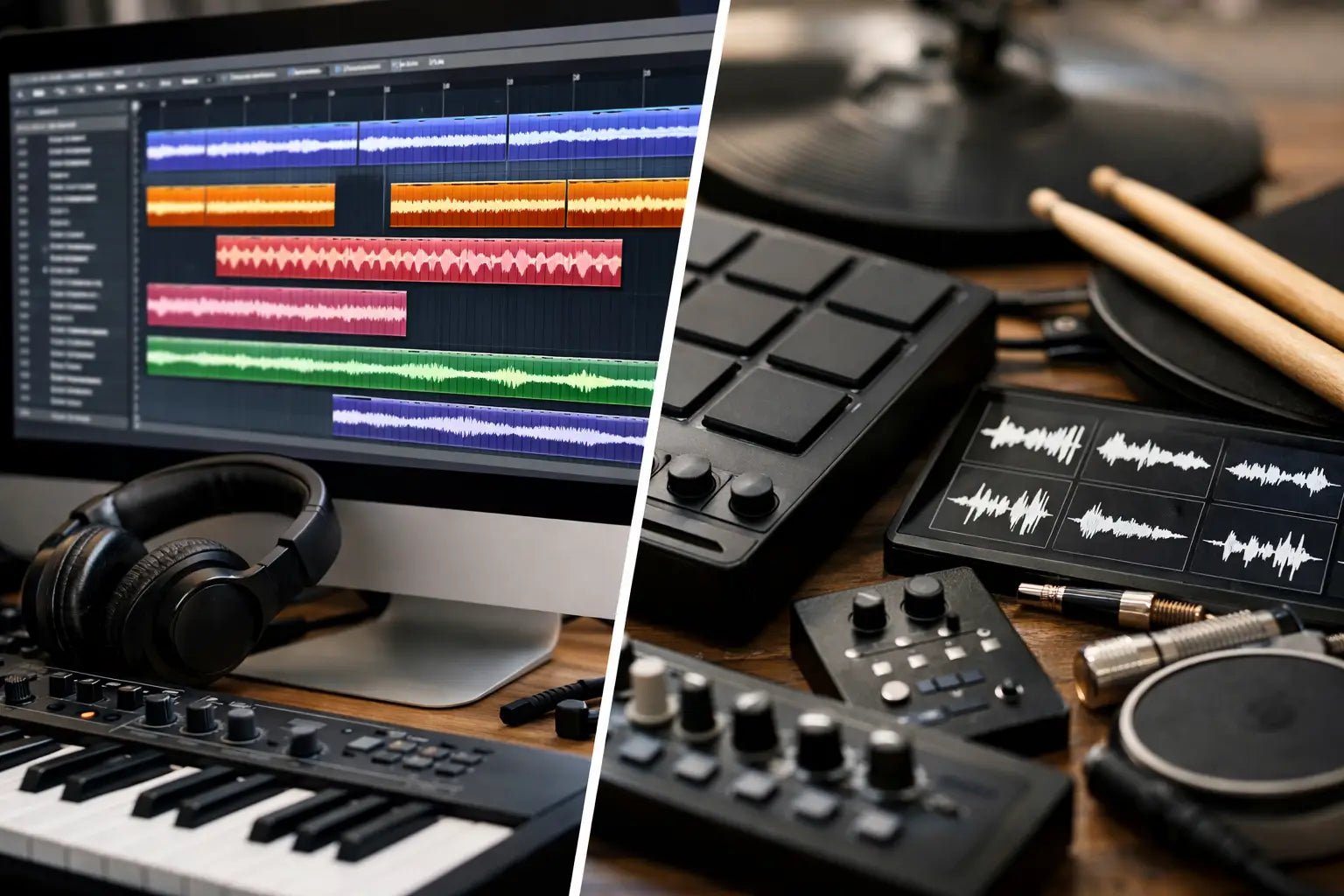
A great drop can lose its impact because the groove feels generic, the drums lack character, or the bass never quite locks with the percussion. That is where the loops vs one shots decision matters. Both formats can get you to a release-ready record faster, but they solve different production problems. Choose the right one at the right moment and your session moves forward. Choose poorly and you can spend an hour fighting a part that was never designed to do the job.
For club-focused electronic music, the best answer is rarely loops or one shots. It is knowing when a finished musical phrase gives you the momentum you need and when individual sounds give you the control your track demands.
Loops vs One Shots: The Core Difference
A loop is a pre-arranged audio phrase that repeats over a defined number of beats or bars. It might be a four-on-the-floor drum groove, a rolling percussion pattern, a bass sequence, a synth riff, a vocal chop, or a complete musical idea. The timing, sound selection, groove, and often the processing are already built in.
A one shot is a single sound designed to be triggered individually. Kicks, claps, snares, hi-hats, percussion hits, bass stabs, piano notes, synth plucks, FX impacts, and vocal phrases can all be one shots. You place or perform them in your DAW or sampler, then shape the rhythm and musical part yourself.
That difference sounds simple, but it changes how you produce. Loops prioritize speed, feel, and instant context. One shots prioritize flexibility, originality, and detailed arrangement control.
When Loops Are the Fastest Route to a Real Groove
A strong loop gets past the blank-session problem immediately. Drop in a percussion loop at the right BPM, add a kick and bass, and you can hear whether the track has club energy within minutes. This is especially useful in Afro House, Tech House, and melodic genres, where small timing details and layered percussion often define the record.
The value is not just convenience. Well-produced loops contain relationships that are hard to recreate quickly: a shaker sitting slightly behind the beat, a conga pattern with natural velocity changes, a top loop with controlled high-end movement, or a synth phrase processed to fit a modern dance mix. Those details make a groove feel performed rather than programmed.
Loops are particularly effective when you need to:
- Build a fast foundation for a new idea or writing session
- Add movement to a drum pattern that feels too static
- Introduce genre-specific percussion without programming every hit
- Create transitions, fills, and tension without interrupting your workflow
- Find a musical direction before committing to a full arrangement
The trade-off is that loops arrive with built-in decisions. Their rhythm may not match your song's pocket. Their reverb may clash with your space. Their tonal balance may compete with your existing drums. A loop that sounds huge in solo can make the full mix smaller if it fills too much of the same frequency range.
When One Shots Give You More Control
One shots are the better choice when the track needs a specific identity. A kick pattern, clap placement, bass rhythm, or synth stab sequence can be the difference between a functional groove and a record people remember. With individual samples, you control every hit, every gap, every velocity change, and every moment of tension.
For drums, this means you can build a kit that fits the song rather than forcing the song around a pre-built rhythm. You can shorten a kick tail to make room for the bass, offset a percussion hit before the downbeat, or remove a clap in the final bar to create anticipation. Those are arrangement decisions, not just sound choices.
Musical one shots go even further. A single stab can become a hook when you play it at the right rhythm. A vocal one shot can become a call-and-response element. A bass one shot lets you write a pattern around the groove of the kick instead of accepting a bass loop's fixed notes and timing.
One shots are usually the stronger option when you are creating the central elements of a track: the main kick, bassline, lead motif, signature drum pattern, or hook. These parts benefit from deliberate writing and variation across the arrangement.
The downside is time. Starting entirely from one shots can slow momentum, especially if you audition hundreds of options without a clear direction. It also asks more of your programming, tuning, processing, and arrangement skills. That is not a reason to avoid them. It is a reason to use them where the extra control will be heard.
The Best Workflow Uses Both
Professional-sounding electronic tracks often combine loop energy with one-shot precision. Start with a loop if it helps you establish a vibe quickly, then build the elements that need personality from one shots. This approach keeps the session moving without making the result feel like a preset arrangement.
For example, begin an Afro House idea with a percussion loop and a simple shaker loop. Once the groove is working, choose your own kick and sub, program a bass pattern, then add individual rim, conga, or clap hits to answer the loop. The loop supplies the rolling momentum. Your programmed parts create the track's identity.
In Tech House, you might use a top loop for shuffle and texture while programming the kick, clap, bass stab, and main percussion from one shots. In Melodic Techno, an atmospheric loop can establish space, but the arpeggio, chord stab, and lead should often be written or heavily transformed so the arrangement develops with purpose.
Think of loops as a high-quality performance layer and one shots as your building blocks. Neither format is automatically more professional. The result depends on how you select, edit, and arrange the material.
How to Make Loops Feel Like Your Record
The quickest way to make a loop sound copied is to leave it untouched from the first bar to the last. You do not need to destroy a great groove, but you should make it respond to the arrangement.
First, check key and tempo. Time-stretching can be useful, but extreme stretching can smear transients or create artifacts that weaken drums. If a loop needs drastic correction to fit, find a better source sound instead.
Next, create contrast. Filter the loop during the intro, remove it for a bar before the drop, or automate a send effect into transitions. Chop a small section for a fill, reverse a hit, or use only the highs from the loop while your own one-shot percussion handles the body. Small edits make a familiar phrase feel integrated into the song.
Finally, protect the mix. High-pass a percussion loop if it clashes with the kick and bass. Tame harshness only when it is a problem, not because an EQ move looks standard. If several loops are competing, mute one. More layers do not automatically create more energy.
How to Program One Shots Without Losing the Groove
Programming from one shots does not mean locking every note perfectly to the grid. Dance music needs precision, but it also needs movement. Start with a clean rhythm, then adjust velocity, note length, and selected timing details until the part feels alive.
Use velocity to create hierarchy. Your strongest percussion hits should earn their level through placement and intention, while supporting hits can sit lower and vary subtly. For hats and shakers, a few controlled changes can create a human feel without turning the pattern sloppy.
Tune tonal one shots to the track. This includes kicks with a noticeable fundamental, bass hits, percussion with a clear pitch, and melodic stabs. A technically strong sample can still sound wrong if its pitch fights the key or the sub. Check it against the bassline instead of trusting the sample name.
Do not feel required to build every layer from scratch. If a drum loop has the right swing, use it. If one individual clap gives the chorus exactly the snap it needs, use that too. Efficient production is about making the right decisions early, not proving how many sounds you can program manually.
Choosing the Right Format for Each Element
For a main kick and bassline, one shots usually offer the control needed for tight low end. For percussion, loops can deliver instant movement, while one shots let you customize the pattern and add fills. For vocals, loops can inspire an entire hook, but one-shot phrases give you more freedom to create your own callouts and transitions.
For synths and melodies, it depends on the role. A loop can be ideal for a supporting texture or a fast writing spark. If it is the lead idea listeners will remember, consider rewriting it with one shots, presets, or your own sound design. That makes it easier to change chords, alter rhythm, and develop the part across the track.
Quality matters more than format. A focused pack with clean labeling, usable key and BPM information, and genre-accurate sound design saves far more time than a massive folder full of filler. Hot Grooves builds its collections around that practical reality: sounds that give producers a credible starting point without slowing down the creative decision-making.
The next time your session stalls, do not ask whether loops or one shots are better in general. Ask what the track needs next: immediate momentum, or a part that only your arrangement can create. That answer will get you back to making music instead of browsing samples.
Using Vocal Loops in EDM for Tracks That Hit Harder
Tech House Trends Shaping Bigger Club Records